Syllabus

Artists

Thursday, November 6, 2014

Using a Grid cube to map your turnarounds

If you get stuck - Go back to your Foundation - 

If you can't seem to draw your character's pose turning in space - simplify it to something you CAN turn in space - like a cube.

Use a Cube to map out where your character's limbs are relative to each other. imagine a sculpture on a block of wood.  have the block of wood just barely fit the dimensions of whatever you are mapping (feet, trailing cloth, elbows, limbs etc.)  use half way marks (or 1/4, or 1/3 ... as many as you like) to give you more landmarks.
Next, map the surface area and where your feet will rest on that cube.  Its easiest if you map these into corners, or touching at least an edge of the cube.

Now draw a cube in perspective over your drawing - you can start with your favorite drawing - the one you want to match all of your other drawings to.  draw your midway marks.  now map out where your character's Limbs should be relative to the map you just drew. 

FEET- Stance

  •  you can even make a smaller mark for where the bone connects into the large shape of the foot - then it is even easier to literally "connect the dots"
  • Take surface area into mind.  If your character is on his toes on one foot, or has a peg leg, map a smaller area than his flat foot.
Map out how his feet would fall on a cube. in this example I have made them just fit in the corners.  his R foot just crosses the middle line.  his back foot Left seems to be on his toes.  it does not cross the middle line.  now I turn this cube in space.  draw the middle lines and map out where his feet will land.


Keep turning that cube in space.  by using this mapping method you will ensure that your points on the map are always  in correct relation one to another and will also help you see how extreme your perspective may be.

Grid Cubes can also be used to figure out perspective on a costume,


Limbs away from the body
Grid Cubes can be place anywhere on the character to map out a limb relative to another


Knees for example


Here is an example of mapping where 2 elbows are, relative to the shoulders. 


Wednesday, November 5, 2014

Jessica Staley - Assignment #6 - Villain


My villain is a neuroscientist. He has an extra large brain, making him extra smart. Instead of using his extra brainpower for good, he wants to steal as many brains as possible. He has developed a method to steal other people's brainpower for himself by stealing their brains. He realizes that knowledge is power, so he wants to steal as many brains as possible in order to have all the power for himself.

Tuesday, November 4, 2014

Sarah Keele ~ Assign #9


The artist I emulated was Jake Panian. I just loved how he is able to use shape and form combined to let the eye kind of fill in the blanks of the lights or shadows. He has a three value rule he follows in a lot of his sketches that I noticed. I tried to follow that here. 

Rebeca Alvarez- Assignment #9


*she will have tattoos 

Kali Ciesemier


I decided to work on shape because I am a very line oriented person. In order to improve on this I picked to emulate Kali Ciesemier because her style is very much shape and color oriented. In order for me to understand how she worked I had to get out of my comfort zone, so I constrained myself and worked only with shaped and color. 

Amber Stotts Mermaid

I chose to do the Jake Parker Method!

Original drawing
Line
 Shapes
 Value
Line and Shape


Rachel Sackett assignment 9

He needs some cleaning.

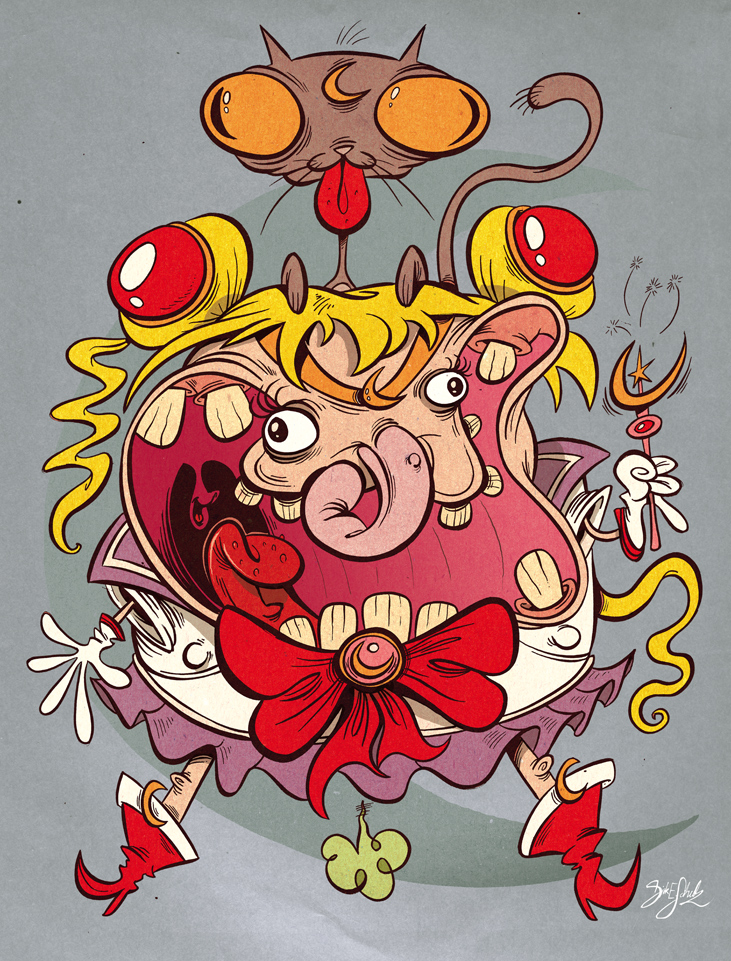
I emulated Dirk Erik Shulz


Ginger Dall Assignment 9


I did the Jake Parker method, and explored line, form, and shape. I tend to stay either on the rendering-form end of the triangle, or a bit on the line. I found the "shape" one difficult, (aka why the 3rd one is not so awesome... unless you're going for a skeletal feel.) I found this exercise helpful!

Note: on the second version,  I think I was subconsciously thinking about Jon Klassen's work (I originally wanted to emulate an artist). The modeling is much flatter/more subtle, and is more about the texture and gradation. The final illustration was born out of TRYING to think sculpturally.

Jon Klassen's work:


Kelsie Liechty Assinment #9


I am very much a line person so I decided to emulate someone from the shape side of the triangle. I chose Maike Plenzke:


I think part of what makes her work appealing is the use of texture and shapes. There's a fun dynamic with brush strokes and also shadows that are clean shapes. I tried this out in my emulation. She's also just great with her choice in color. It's all very rich. I went with a complimentary color scheme with mine.

Ethans Emulation Anthony Holden


Stacey Sleight - Emulation

 No altered lines:
With altered lines:
I decided to combine two artists for this particular assignment. I wanted to emulate the shape language of Nico Marlet (since everything he touches becomes beautiful no matter the ding dong shape). I admire his consistency in using similar shapes throughout a design. The other artist I chose was an artist under the name of Zarnala (you can check out their deviantArt page below). This artist uses line effectively by creating realistic bends and folds as well as coloring their lines to create a pleasant, but convincing sense of light and dimension.

Nico Marlet


Zarnala


Website: http://zarnala.deviantart.com/

Garrett Hamon - Assignment #9


I have chosen to emulate Elliot Alfredius. Since discovering this artist I have really admired his whimsical and creative style, there is something always unexpected about it. I tried to emulate his line work and shape language.

Sarah Thulin Exploring the Rendering Triangle

Original Sketch


Melissa Vance-Assignment #9

Wasn't sure if we were allowed to do mythical beasts, so there is a person on there...

Inspired by Justin Gerard. I think his work is really appealing because of the shapes he uses and the way he shows form. He has a way of using straight shapes in a way that makes them look curved. He also uses very little obvious line work in his paintings (even though he clearly knows how to use it in his drawings) and definitely manages to get his point across with his shading. I was trying to emulate him with the shapes I used for the dragon and the girl. He has a similar body type that he uses in his girls and I attempted to use that in my mermaid person. His monsters/animals also have a similar shape and he tends to re-use positions. Someone once told me that a large part of emulation was not only drawing like the artist, but looking at how they positioned their characters and backgrounds, I'm not sure if this is always true, but I wanted to make sure that I tried out his way of drawing characters. I was really inspired by his forms, I tried to shade like him a bit though really unless I had not used line (which I did when I forgot what I was doing) and just shaded the way he did I wouldn't have (and didn't really) succeeded.  

Justin Gerard, a girl on a snail

Amy Clegg Assignment #9


 I chose to emulate Pascal Campion- I loved the shapes he uses, and that's definitely my weakest area. So in order to keep myself from being tempted to focus on line or form, I did my character in cut-out construction paper. I learned a lot from this project! I just wish I'd had more colors of construction paper to work with- Pascal's work also shows a bit of form because of the different patches of color that he uses within the characters.


Monday, November 3, 2014

Animal Character Design - Anthropomorphism


Anthropomrphic Character Design in animation and Sequential Art:

The Symbolic use of the animal to portray personality
by
Tim Jardim

Anthropomorphism - The attribution of human form or other human characteristics to any nonhuman object."

1) Emotional Appeal
2) Realm of Fantasy
3) Proximity to Human
4) History
5) Symbolism
6) Gender

"What purpose does the animal play in telling stories? Why do viewers appear to form a connection with animal characters that can be as Strong or stronger than the bond with a human cast? what can the choice of animal in a story tell you about that character.?"

2)Realm of Fantasy

anthropomorphic characters place narrative into the realm of fantasy (pg 6)

Burke - "When political, religious, social, or personal risks are high, when we are standing close to the metaphoric fire, the use of animals has long provided intellectual and psychological distance and allowed us to critically explore that which we would not be comfortable exploring directly.

3)Human?

two categories of bipedal, clothes wearing, tool wielding animals.
1) animals existing in a human world - alongside humans who see animals this way as a normal occurrence - Beatrix Potter
2) Human are non-existent and have been replaced with animals.  Animals are still mostly animal. Most physical features remain unchanged except for adaptions to use human implements such as opposable thumbs and dexterous hands. - robin hood , kung-fu panda
3) Animals are more Human than animal.  Bodies identical to our own with animal features tacked on. Basically just an animal head on a humans shoulders w/ a few other props such as tails or wings.
4) Humans, but with animal traits mixed in either in appearance or in behavior. (pg 4)

Watership Down
Beatrix Potter
Aesop's Fables

When is a Cartoon Character Naked?

"When is a cartoon character naked? It may be argued that all cartoon creatures are naked if they have no costume, but this Is clearly undermined by the example .. in which bodily fur is treated as an outer garment... (pg33)

3)Gender


P. Wells (understanding animation) quotes Delguadio:  "Anthropomorphic characters are a step removed from human characters and require a certain degree of imitation or impersonation of human traits in order to succeed.  ... The major difference in [Gender] is seen in the degree and type of abstraction: whereas the male characters are abstracted to actions and 'masculine' traits (for example, cunning, aggressiveness), the female characters are abstracted and reduced to physiological characteristics and 'recognisable' feminine traits (for example, shrewishness, passivity) (pg 11)

Male - defined by behavior
Female - defined by appearance and vocabulary

Male - "Generic". Gender neutral or androgynous animal characters are usually assumed to be male
Female - must be viewed as "special" - out of the ordinary. Distinctly feminine.

Discuss Minnie and Mickey mouse, Robin Hood and Maid Marian


4)History

Spiritual protectors
Egyptian Gods
Virtues - Aesops fables
guardian spirits - totems
animal symbols
Sacred animals

5) Symbolism
Robin hood - non human silhouettes.  Most animals seem to exist as one of their kind, unless a family or couple is depicted - It is easy for a viewer to determine that these two characters "belong" together since they are of the same species.  Maid Marian - made more feminine through the use of mannerisms, features and props.
Fox - cunning and sly
Bear - " a creature of contrasts" - enormous strength, but thrives on fruit and honey. - gentle giant, compassionate, friendly
Prince John - Lion, king of the jungle.  no full mane = inability to be a fit ruler
King Richard - true king
Sheriff of Nottingham - wolf - minion, enemy, menacing animal.
Peasantry - badgers, mice, farmyard country animals
Soldiers - foreign or predators to village animals (pg 28)